When physical systems resist, what do we do?
We add more heat. More pressure. More margin.
But what if the answer isn’t ‘more’
but better timing?
Tuning, not over-powering.
scroll gently

That’s the world CCT Labs is leading us toward.

A different relationship with matter

Engineering is about to change in the same way computing changed when software arrived. Not because physics loosens its grip, but because we are learning how to get far more out of the same world by shaping conditions instead of simply overpowering resistance.

Timing, field shape, and feedback start to matter alongside heat, pressure, and margin.

The first signs appear where brute force is expensive and precision changes the outcome: in space, in manufacturing, and in computation.

Space
01 / 03

Space starts to change when a vehicle no longer has to do everything alone. Guidance, sensing, and correction can be handed off to support already in orbit instead of being carried from launch as onboard burden. Orbital space starts to feel less like empty distance between isolated machines and more like an engineered medium.

Orbital Medium

What this opens up is a civilization that travels farther with less onboard burden, makes things with less waste, and draws useful computation from the physical world in new ways.

Scenes from that world

Space

Orbital handoff

At the edge of night, a cargo tug slips out of parking orbit carrying less propellant than old mission planners would have accepted. It leaves lighter because part of the mission is already waiting for it: relay nodes, precision timing, synchronized sensing, service platforms, and coordinated control spread across the route ahead. The craft is still bound by real constraints, but it is no longer hauling all of its fate onboard. It is entering a managed medium.

The same logic pushes further. Once orbital infrastructure is trusted enough to hand off guidance, stability, and correction, engineers begin probing a stranger question: whether the effective paths that signals take through an environment can be shaped as deliberately as the vehicles moving through it. That horizon stays later and harder, but it belongs here because space has stopped feeling like empty distance and started feeling like engineered coordination.

Manufacturing

In spec, one pass

On one side is the older manufacturing logic: add more heat, run a broader pass, and leave extra margin in case the part misses the mark. On the other is a process that watches the part as it moves and trims timing, energy, and position quickly enough to keep the transition where it needs to be. The finished part may look the same, but the question has changed. Instead of asking how much more force the line can apply, engineers start asking how much more control they can get from the energy already being spent.

That difference shows up in the numbers operators actually care about. More parts land in spec on the first try, fewer get pushed into rework or scrap, and the line wastes less energy forcing every unit through a wide process window. Precision stops being a special lab trick and becomes a real production advantage.

Computation

Physical co-processor

A scheduling stack hands one hard subproblem to a physical co-processor mounted beside the main system. Instead of brute-forcing every path in software, the module shapes a real optical or resonant medium, lets it settle, and reads back an answer. For the right optimization or sampling jobs, the benefit is practical: useful work arrives with less power, less heat, and less brute-force hardware chewing through the search.

That is when the category changes. The device is no longer a curiosity on a demo bench. It is a rack-level module the system calls when physics can reach the answer more directly. The data center does not disappear, but some expensive workloads stop scaling only through more chips, more cooling, and more floor space.

Portable results

For those futures to matter, the underlying effects have to survive handoff. A result becomes truly valuable when it keeps the same meaning as it moves from physics into hardware and from hardware into manufacturing. That is how an observed effect stops being a one-off claim and starts becoming a usable engineering method.

This is where science changes shape. A discovery is not finished when it is first seen. It becomes complete when it can be carried forward, compared, reproduced, and trusted enough to anchor real engineering.

That is the threshold where a future becomes buildable.

Same result, carried forward

Why this starts with a reference lab

A world like that does not arrive through isolated demonstrations. It begins when promising effects survive comparison, translation, and reuse.

CCT Labs is being built as a reference lab for programmable physics: a place where theory, simulation, hardware, and measurement stay in the same loop until a result can be trusted, reproduced, and carried forward.

The aim is to turn controllable physical effects into validated methods, reference devices, and reproducible benchmarks that other engineers can use, compare, and extend.

That work is grounded in the Continuum Computation Thesis: that physical evolution and information processing are two views of the same feedback process, and that this makes programmability a real engineering question rather than a metaphor.

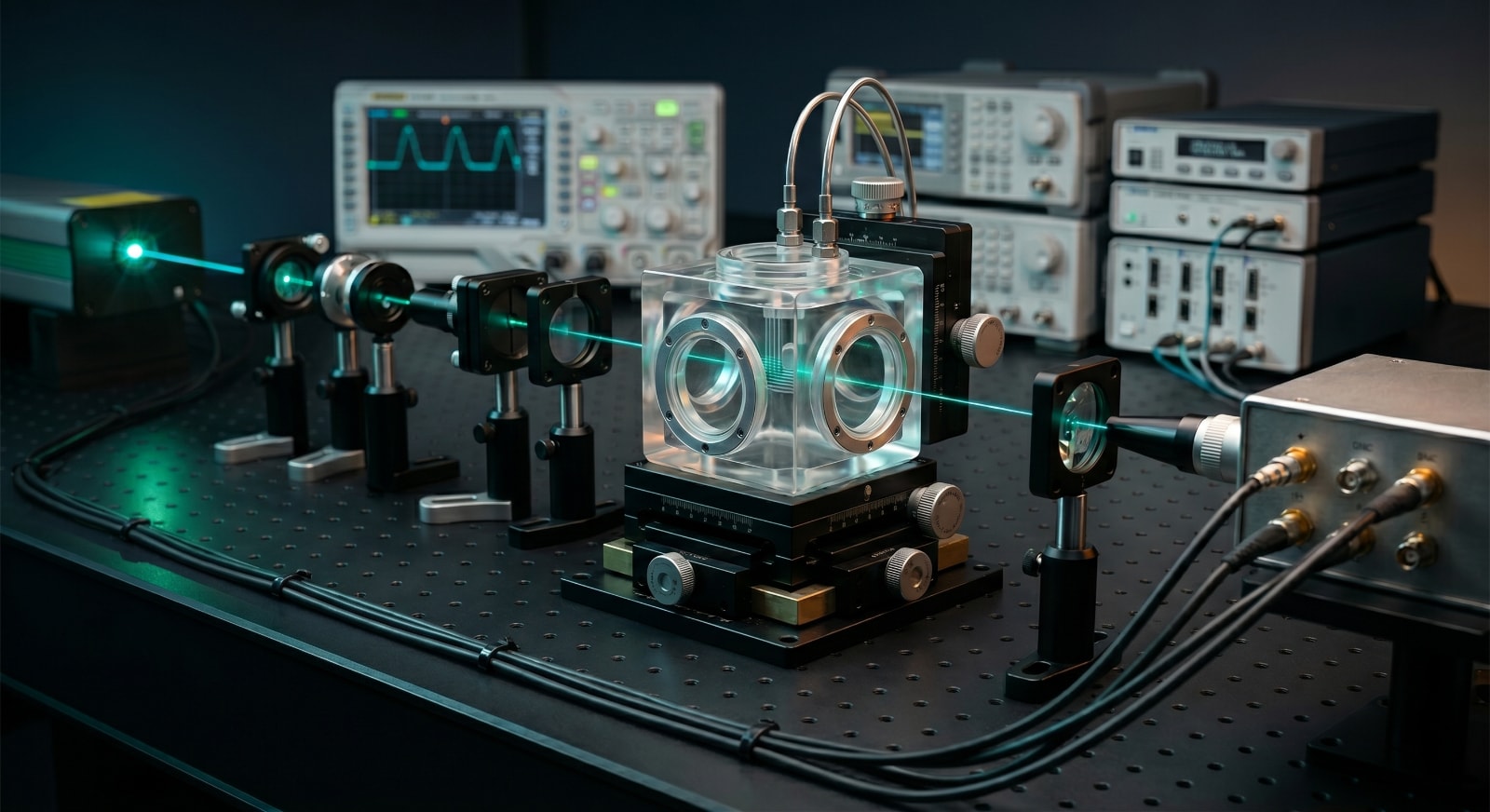
Advanced photonics control bench with a central optical test fixture, aligned optics, and measurement instruments.

That is why CCT Labs has to exist: not as another place to admire interesting phenomena, but as the reference layer that carries results from physics into hardware, from hardware into manufacturing, and eventually into real systems.

In computing, the decisive shift came when shared layers made powerful machines consistently usable. This is the physical analogue: a reference and control layer that makes controllable effects portable across domains, with space as the long-horizon destination.

CCT Labs is building it now.